NIPPONGAKUTV#2 Ryu&Shiyu (Azavana)
After experiencing your first overseas performance in Shanghai, you are now appearing in Paris for the first time in front of a European audience. Which lesson from the Shanghai show has had the greatest influence on how you prepared today’s performance?
Shiyu: The Shanghai show was a major first for us, even before Azavana officially began. It allowed us to connect with people who already knew about us, and it felt like the first time we had truly met them. There were so many people who told us they had finally been able to see us live.
Ryu: Not only people from China, but from other countries as well.
Shiyu: Yes, people had travelled from nearby countries too. It made us realise that, if we had stayed only in Japan, or if we had given up on music during the pandemic, we would never have met those people who had been waiting for us. That experience became our biggest motivation to perform overseas again.
Ryu: We did some research beforehand, but everything happened so quickly that we soon found ourselves in France. We would also like to visit other countries and meet fans from many different places. We are really looking forward to showing overseas audiences the same 100% that Azavana brings to the stage in Japan.
B7KLAN brings together bands representing different generations of the visual kei scene. As a band that officially began activities in September 2024, what new value or perspective do you believe Azavana can bring to this event precisely because your history is still being written?
Ryu: We have been active for less than two years, so it is an honour to perform alongside legendary visual kei bands with much longer histories. Naturally, we feel nervous, but we are also determined not to lose. In spirit, sound and performance, we want to stand on the same stage as them and give everything we have. Today, especially for the European audience, we want to deliver Azavana’s music to people from many different countries.
In less than two years, you have released your first full-length album, held a headline show at Zepp Shinjuku, performed overseas for the first time in Shanghai and now reached Paris. At what moment did you feel that Azavana had developed its own distinct identity, rather than simply being a combination of five individual musical histories?
Shiyu: I think Azavana’s identity really began to take shape during our first one-man tour, the Akashi tour. That was when I felt that the essence of Azavana, especially what we are as a live band, became established.
With the completion of our first full-length album, I feel that the starting point we found on that tour has now taken a clear form.
The title of your first full-length album, “Ikiteitai Nagaretsuita Kono Machi de” (“In This Town Where I Drifted and Want to Live”), comes from a lyric in “Haiiro no Umi wo Oyogu Hotaru” and represents the place where the five of you arrived as Azavana while continuing to value your past intentions and experiences. After performing these songs live over time, has that phrase acquired a different meaning or emotional resonance from when you first created the album?
Shiyu: Those words definitely reflect the very beginning of Azavana. The lyrics were written by our vocalist, Ryo, and I believe they reflected his state of mind at the time.
When we released our first single, “Haiiro no Umi wo Oyogu Hotaru,” each of us was playing in a different band and based in a different place. We were all at a point where we had to decide whether to continue making music or not. We chose to continue, and that was how Azavana began.
At the time, there was a very strong feeling that music was something we wanted to make our lives through. Now we are touring and have created a new album, so I feel that our sound has changed in some way.
Ryu: It feels as though we have moved from searching for answers to finding possibilities.
You explained that the album was not intended to be merely a collection of completed songs, but a work whose narrative could be felt by listening from beginning to end. When condensing that world into a limited festival set, which songs or elements did you consider essential for communicating the current story of Azavana?
Shiyu: For a shorter set, especially at an overseas event, we focus on songs that can clearly represent Azavana. The approach differs from a run of one-man shows in Japan, where the same audience may attend several dates and we can build more variety into the setlist.
Our lead tracks are always important at key moments, but we still try to include unexpected choices. I think today’s set will have a few surprises.
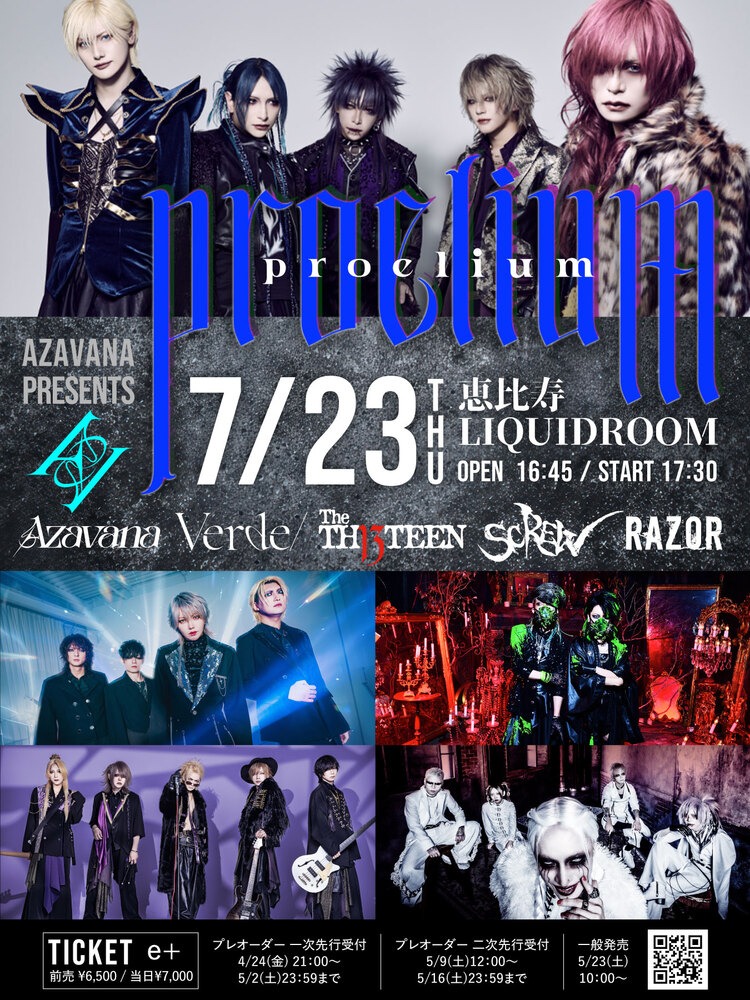
After the Paris performance, you will hold your own event, “proelium” featuring bands from different generations and with different musical identities. When constructing the lineup, what kind of stimulation, dialogue or musical chemistry did you hope would emerge between those artists and generations?
Ryu: Performing overseas and sharing the stage with local bands and senior bands we have not yet had the opportunity to play with in Japan will allow us to learn and absorb a great deal.
Shiyu: We also held Proelium last year as a series of ten two-man shows. The title was chosen by Ryu and has a meaning close to “battle.”
Ryu: That’s right.
Shiyu: This year, it will be one focused event. Last year’s line-up brought together junior, peer and senior bands, but this time we want to challenge our seniors and put all the strength we have built up into that encounter. It is about younger bands taking on more experienced ones.
Of course, the senior bands will not be intimidated. Because we know each other personally, it becomes a clash built on mutual respect. I think they will respond with love to the younger bands challenging them, and that is where a real synergy can emerge.
In September, you will celebrate your second anniversary with the concert “Zankyou”, and in December you will return to the stage at Zepp Shinjuku. Almost ten months after your previous Zepp performance, what growth or change do you want to demonstrate in your music, your live presentation and the relationship between the five members?
Ryu: Our first Zepp show felt like we were pushing ourselves to our limits at that time. However, we were also moving forward without having had many opportunities to compare ourselves with other bands. Afterwards, through events such as “Gomeikyo,” we were able to see where we stood and learn from other artists.
We have continued to absorb the strengths of other bands and recognise the areas where we need to improve. For our return to Zepp, we want to bring back a more powerful sound, new arrangements, perhaps more songs and a different approach to the setlist. We want to return to Zepp Shinjuku stronger than before.
Shiyu: Not only the band itself, but also the team around us has developed considerably. Rather than simply rushing towards a tour final, we need to create a stage production truly suited to the scale of Zepp Shinjuku. We want to become a band capable of delivering that kind of complete performance.
What does Azavana need in order to take the next step towards touring outside of Japan?
Ryu: We were kindly introduced at this event as one of Japan’s rising visual kei bands. We hope promoters from countries such as the United States, South America and elsewhere in Europe will see us and think, “We want Azavana in our country too.” That is what we want to show through today’s performance.
Which two countries would you especially like to visit?
Ryu: Spain and Germany. We would also love to visit Brazil. It is very far from Japan, so the flight would be difficult, but we would still like to go.
Shiyu: France was difficult too.
Ryu: France was difficult too. It’s hot!
Ryu: Thank you very much, NIPPONGAKU. See you!