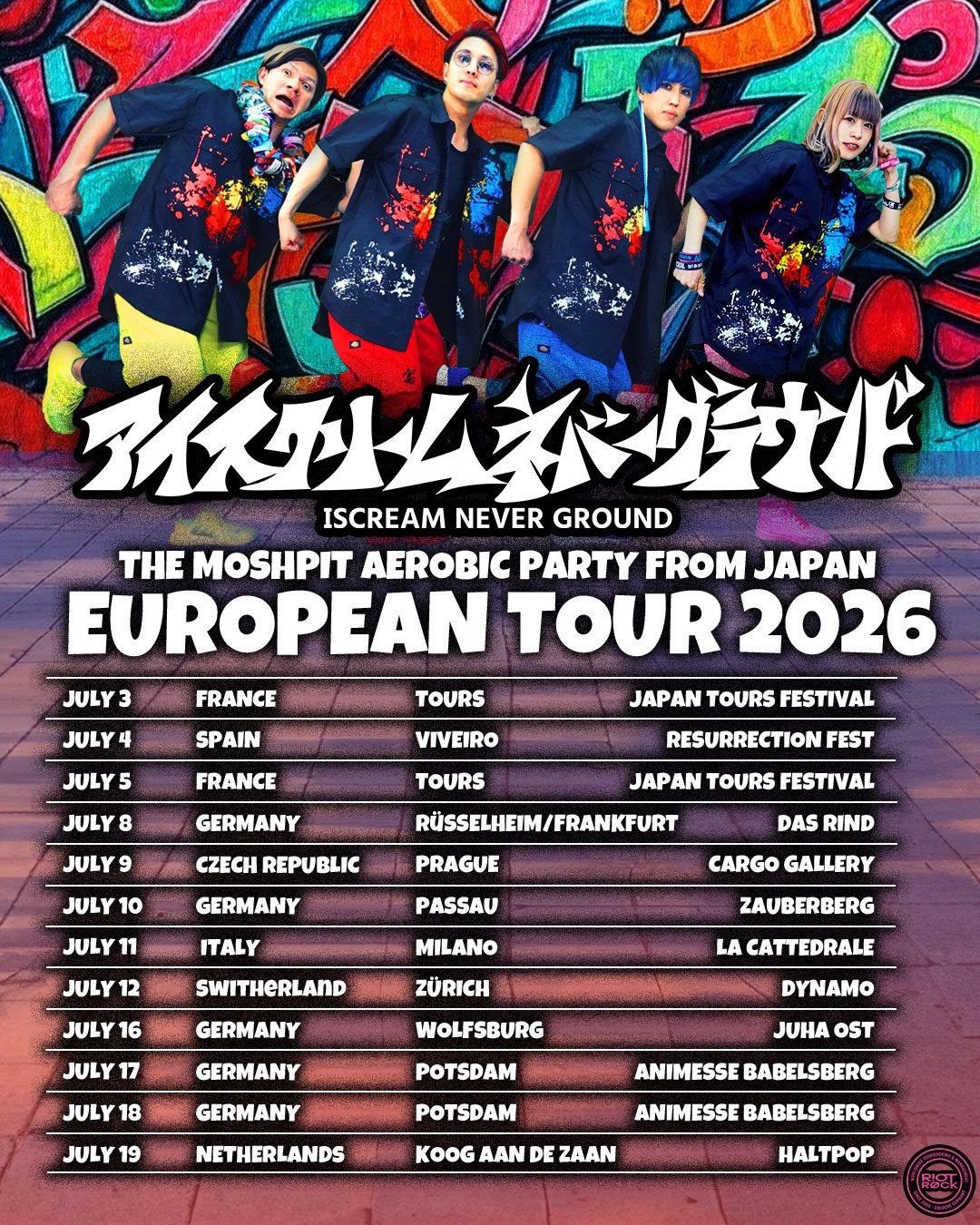
ISCREAM NEVER GROUND – RESURRECTION FEST 2026
In this written interview, Bob, leader of ISCREAM NEVER GROUND, discusses the band’s return to Resurrection Fest, the careful planning behind their seemingly chaotic performances and the challenges of building an international career independently.
To begin, could you briefly introduce yourself and explain your role within ISCREAM NEVER GROUND?
I’m Bob, the leader of ISCREAM NEVER GROUND. Onstage, I play bass and handle the sequences and VJ production. Beyond that, my main responsibilities include writing the lyrics and music, overseeing the merchandise design and managing the band independently.
Last year, you made your Resurrection Fest debut on the Chaos Stage, while this year you moved up to the Main Stage. What did you discover about yourselves and the European audience through last year’s performance? How did that experience influence this year’s show? Once you stepped onto the stage, did you notice any differences from the previous year?
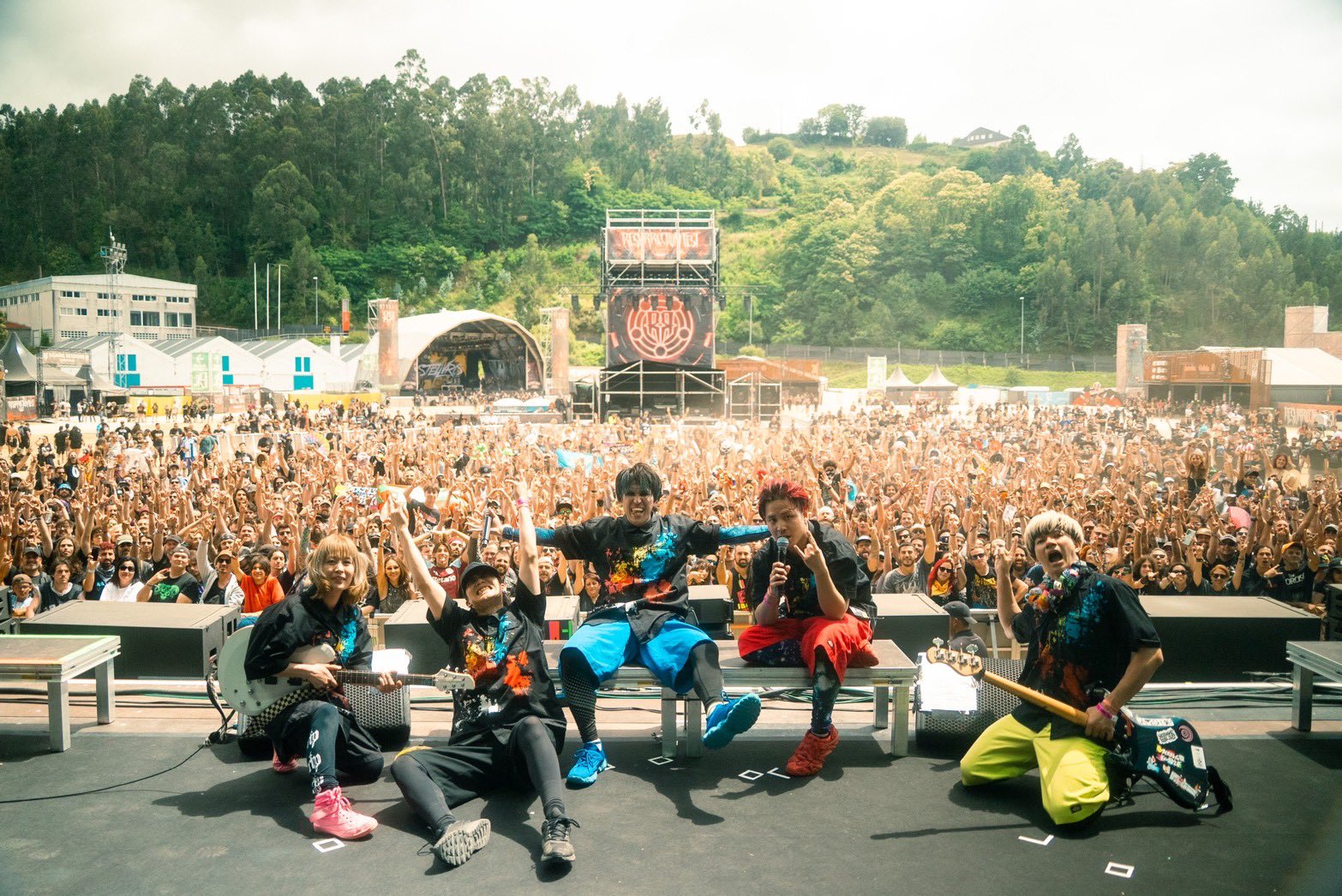
Last year, everything was completely unknown to us. We could not even imagine what kind of view would be waiting for us.
Then the intro started, and the moment we walked onto the stage, we saw a crowd stretching as far as the eye could see. I remember being incredibly moved by the realisation that our music had managed to reach somewhere so far away.
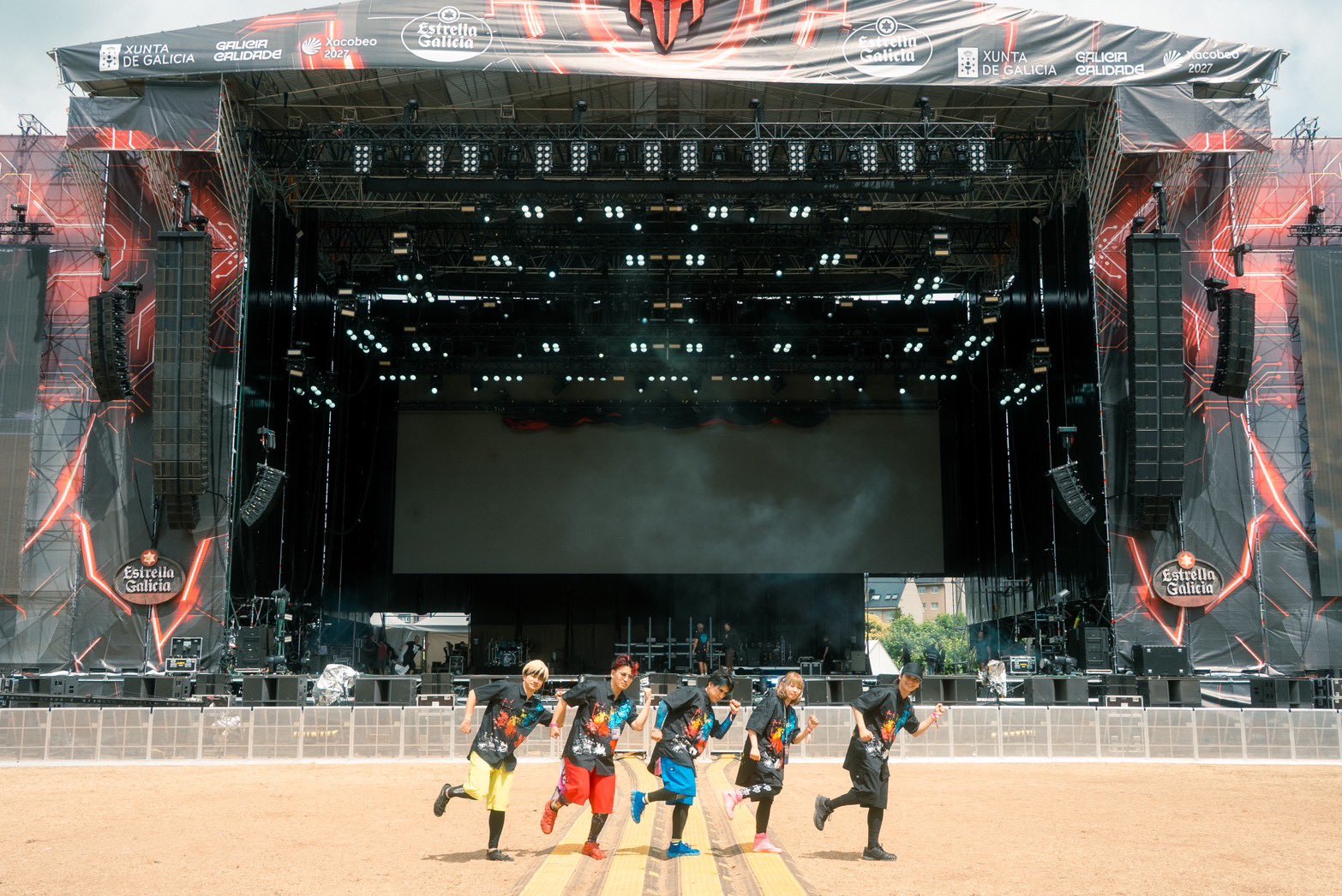
This year, we were offered a slot on the Main Stage, but because we were opening the day, anyone who wanted to see us had to wake up early (laughs). That made us change our mindset. Rather than seeing ourselves as guests who had been invited to Resurrection Fest, we approached the day as the band responsible for getting the festival started and beginning to build its atmosphere.
On top of that, some of our baggage was lost during our flight from France to Spain that same morning. Part of our equipment, some instruments and our stage outfits were left behind in Paris. It was a day that tested us in many different ways.
One of the factors that helped ISCREAM NEVER GROUND become known outside Japan was your short-form content on social media. What aspects of the band can be communicated in a video lasting only twenty seconds? Conversely, what can only be understood by experiencing one of your concerts in person?
I think we have an immediately recognisable visual appeal. There are not many bands combining such an aggressive sound with outfits featuring so many vivid colours.
In our videos, we try to display the lyrics whenever possible, while also making sure that the visuals in the background do not move excessively. We pay close attention to how much information is being presented to the viewer at once.
Many of our lyrics also contain ideas that may initially seem incompatible with such a hardcore sound. That contrast may be what encourages people discovering us for the first time to leave comments and reactions.
As for what can only be experienced in person, we place great importance on the impact of the band’s live sound. That is probably the biggest element.
We do not believe that impact can be fully conveyed through a short video watched on a smartphone. For that reason, we often replace the live audio with the original studio recording, which is easier to listen to through a phone. From an algorithmic perspective, it is also more advantageous when the platform recognises that the same official track is being used, particularly when the aim is to increase the video’s reach.
Your concerts appear extremely chaotic and spontaneous. At the same time, getting a large audience to move and participate together must require very precise preparation. Within that chaos, which elements are planned in detail beforehand? Which parts genuinely change in the moment depending on the audience’s reaction?
My mindset is quite similar to that of an athlete. I believe in preparing and anticipating things carefully, then creating an environment in which we can deliver one hundred per cent of what we have prepared. Because of that, I think we plan a great deal in advance. We also pay very close attention to how one song flows into the next.
Especially when performing overseas, we use prerecorded announcements and MC segments in the local language. That means our ability to imagine what each show will be like beforehand is really put to the test.
I often spend the previous day or the journey to the venue carefully working on those messages. Even so, once we arrive, we frequently replace them at the last minute so that they feel as close as possible to something being said in real time.
We want each performance to reflect as many elements of that particular day as possible.
One of your goals is to turn the entire venue into one huge participatory playground. Overseas, many audience members do not understand Japanese and are unfamiliar with the movements or rules associated with each song. How do you communicate what they should be doing without relying on language? Do you also think about how you want the audience to move while composing the songs?
With our earlier material, particularly up to our first album, Asobi Viva Revolution, we often came up with the audience movements at the same time as we were writing the songs.
The problem is that we more or less used up all the movements we originally wanted to try during that period (laughs).
With our more recent songs, we usually finish the music first and then introduce movements we have not used before at points where we think they will work most effectively within the flow of the performance.
We use our social media videos to show people those movements. At venues where it is possible, we also use the VJ visuals during the show.
In reality, the way we communicate them is not particularly different in Japan and overseas. People usually understand very quickly. We have the impression that, regardless of the country, the people who enjoy watching us tend to be highly adaptable (laughs).

At your concerts, the audience does not simply receive the music but becomes an active part of creating the performance. Has the audience ever reacted to a song in a way you had not anticipated, with that reaction eventually changing how you performed or presented it live?
That has happened several times. In Tokyo, for example, there is a group of people trying to spread the Viking mosh during the breakdowns of certain songs.
However, from the perspective of designing the concert as a whole, it can be a difficult balance. Some things are entertaining precisely because they arise spontaneously, while others work because they become established rituals or recognisable conventions. Each has its own appeal.
We tend to place greater emphasis on the rituals and established patterns we envisioned from the beginning.
For example, during a melodic chorus, we firmly believe that stage diving or crowd surfing fits much better than running around in a circle pit. There are certain core principles that we do not want to compromise.
Even so, we are constantly searching for the ideal balance between the two.
If you could watch only one moment from today’s concert through the eyes of the audience, which would you choose? What would you look for to determine whether you had truly managed to involve the entire Main Stage?
I would choose the section of STAY GROUND, one of the songs we performed towards the end of the set, where we shout the names of different countries and regions.
Last year, while we were still writing the song, our appearance at Resurrection Fest 2025 was confirmed. That fitted the concept we had originally imagined for the track, so we decided to include the names of the countries and regions we had visited through our activities, even if we had only managed to set foot there once.
Because of that, you could say that half of STAY GROUND was born thanks to last year’s Resurrection Fest.
This year, we were able to perform the song on the Main Stage. Shouting the name “Viveiro”, which appears in the lyrics, while actually standing there was undoubtedly one of the highlights of this year.
You recently released “42283”. What does this song represent for ISCREAM NEVER GROUND at this point in your career? What does it bring to your live performances that was not present in your previous material?
The song is about the Dickies 42283 shorts that we have worn for almost nine years throughout the band’s career.
It came about after we received an offer for an official collaboration from Dickies Japan at the beginning of this year.
Around ten years ago, it became a local trend at Japanese rock festivals to attend summer events wearing Dickies shorts in a wide variety of colours. I belong to exactly the generation that experienced that trend firsthand.
The idea behind the song was to revive that carefree style of dressing and completely letting yourself go at a concert.
To be honest, it was not written with this overseas or European tour particularly in mind (laughs).
However, partly thanks to the choreography we added afterwards, it became a song that generates a much stronger live reaction than we had expected. I think it will become an important part of our setlists from now on.
Your songs move rapidly through many different sections, while the three vocalists each have distinct roles. How do you decide who sings or screams each part, who introduces the songs and who leads the audience? Were those roles clearly defined from the beginning, or did they gradually take shape through performing live and observing the audience’s reactions?
We basically decide everything while recording each song during the production process.
In our early years, we often wrote each section with a particular vocalist already in mind. More recently, however, we have had all three vocalists record every section where we think they could potentially work.
Afterwards, we listen back and select the most suitable voice while adjusting the arrangement, taking into account elements such as vocal tone and the energy of each performance.
Regarding the overall flow of the concert, we decide the major MC sections in advance, including those delivered as prerecorded announcements. The two male vocalists also coordinate details such as who will introduce each song.
You continue to operate independently and have also used crowdfunding to produce music videos in Europe. How do you decide whether to take on a major challenge of that scale, including the financial risks involved? In the work made possible through your fans’ support, what did you want to capture in Europe that could not have been expressed by filming only in Japan?
The crowdfunding campaign for the music videos was the project we carried out last year.
Our appearance at Resurrection Fest had been decided quite suddenly. We launched the project because we wanted to do everything within our power to ensure that the trip would not end with a single performance, but instead lead to future opportunities.
The music videos we produced were STAY GROUND and 2STEP 3FUN 4LLOWING (Broken English ver.).
Some of the members obtained their first passports and travelled overseas for the first time. I think we were able to tell a story that was uniquely ours: the story of a band finally leaving Japan and venturing out into the wider world.
We also feel that the experience directly led to this year’s tour.
As for the crowdfunding project we carried out this year, the European tour was greater in both scale and duration than anything we had previously undertaken, even in Japan.
Our aim was to complete it safely without compromising the quality of the production, and then use it as a foundation for expanding further in the future.
For us, it is not really a question of deciding whether or not to accept a challenge. When an opportunity appears, we immediately decide that we are going to pursue it. The question then becomes how to make it happen, and crowdfunding has been one of the methods we have chosen.
This was already our fourth crowdfunding campaign, so perhaps we have become slightly accustomed to running them. We also use them as an opportunity to receive support from our fans and organise community events that could only happen at that particular moment.
During this tour, you will perform at metal festivals, events related to Japanese culture and live music venues. Do you change the way you present the band or structure the performance depending on whether the audience has come for heavy music, is interested in Japanese culture or is specifically there to see ISCREAM NEVER GROUND?
We adjust the setlist to a certain extent, but our fundamental style remains the same.
We want to offer everyone the same experience of moving their bodies as much as possible to the sound of the band.
We cannot reduce the screaming or soften the distortion simply to suit a particular event (laughs).
Many events connected with Japanese culture also lean towards the geekier side, with a strong focus on anime, video games and similar interests. I consider my own roots to be closely connected to that world as well.
Because of that, we try to communicate to those audiences that we are standing on the same Ground as them.
After completing thirteen shows across seven countries, what would need to happen for you to feel that you had not simply delivered a series of good concerts, but had genuinely established a solid fanbase in Europe? Are there any countries or cities where you have not yet performed that you would particularly like to visit?
This may sound very specific, but I think the answer will depend on whether the scale of the booking offers we receive for future tours begins to grow.
We are a band particularly suited to outdoor festivals, so it will be important to see whether the number of offers from those kinds of events increases.
That does not mean we dislike performing in live music venues (laughs). Venues with good sound and comfortable temperatures are also amazing.
During this tour, we have not been able to visit northern Europe, including the United Kingdom, so we would like to perform in those countries.
In the United States, we have only performed in Texas so far, so we would also like to visit a much wider range of regions.
And Chile. For some reason, when our short videos first began gaining traction, it was one of the places where our listener base grew most rapidly.
Because of that, it is one of the countries in South America that interests us the most.
Someday! (laughs)